
Drywall Types in Canada: Which Board Belongs Where?
A practical guide to standard, moisture-resistant, fire-rated and sound-control gypsum board, including where each type is appropriate and what it cannot do.
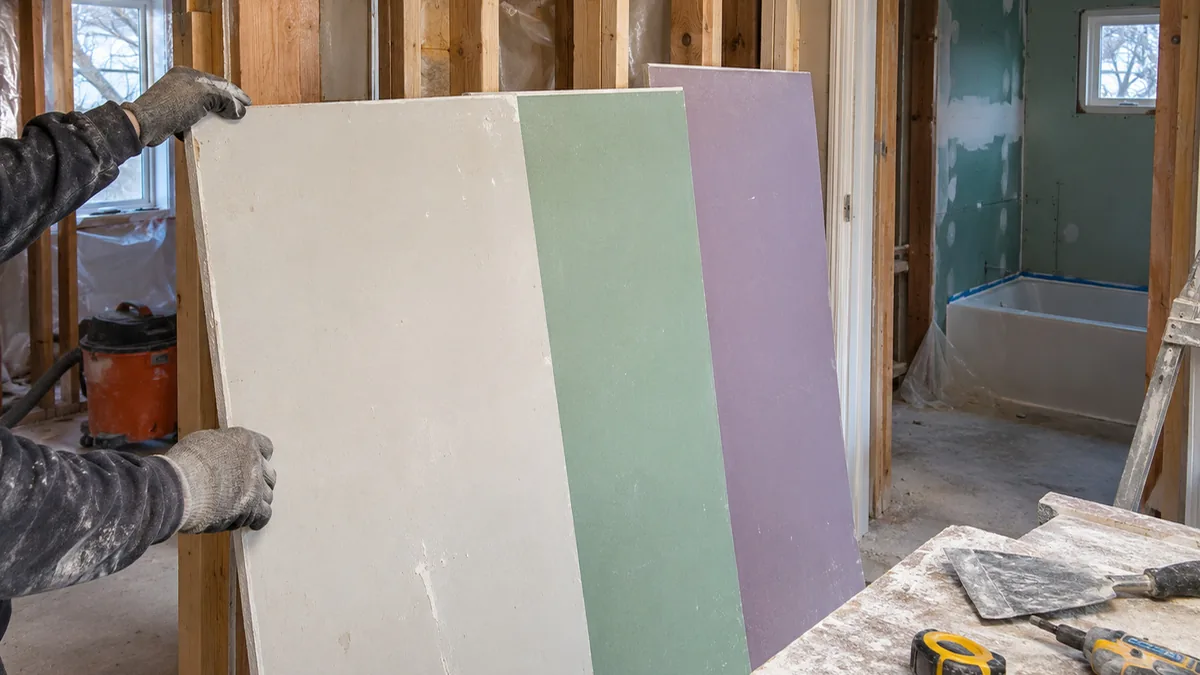
The right drywall depends on the wall or ceiling assembly, not simply the room name. Standard gypsum board is common in dry interior spaces. Moisture-resistant panels may suit some damp locations, but they are not waterproof and do not replace a shower’s required waterproofing system. Fire-rated and sound-control boards are components of tested assemblies; choosing a special panel alone does not guarantee a fire rating or a quieter room.
Product names and permitted uses vary by manufacturer and building code. In Canada, check the product’s current technical data and the applicable provincial or territorial code before specifying it. This overview helps homeowners ask better questions; it is not a design or code approval.
Common board categories
| Board category | Typical role | Important limitation |
|---|---|---|
| Standard gypsum board | Interior walls and ceilings in ordinary dry spaces | Not intended to solve moisture, impact, acoustic, or fire-separation requirements by itself |
| Moisture-resistant board | Certain damp interior locations where the manufacturer permits it | Not waterproof; not a substitute for a complete wet-area waterproofing system |
| Type X or other fire-resistance-rated board | Used as part of specified fire-resistance assemblies | The rating depends on the complete tested assembly, including framing, layers, fasteners, joints, and penetrations |
| Abuse- or impact-resistant board | Areas that need improved resistance to dents or surface damage | Does not make a wall indestructible; confirm the product’s tested use and finish requirements |
| Sound-control board | May help an assembly reduce sound transmission | Board alone cannot deliver a sound rating; gaps, flanking paths, framing, insulation, and assembly design matter |
| Flexible or specialty panels | Curves, specific installation conditions, or manufacturer-defined uses | Follow panel thickness, framing, fastener, and finishing instructions exactly |
The labels above describe broad product families, not interchangeable specifications. Read the manufacturer’s sheet for the actual product under consideration.
Standard board
Standard paper-faced gypsum board is used on many interior walls and ceilings. It is available in different thicknesses and edge profiles. The correct thickness and orientation depend on framing spacing, ceiling application, local requirements, and manufacturer instructions. A contractor should not assume a panel used on a wall is automatically appropriate overhead.
Standard board is not a water-management system. If a wall is expected to get wet, the assembly needs a suitable design for that exposure. If water has already damaged the material, see our guide to wet or water-damaged drywall before covering the surface.
Moisture-resistant board and wet areas
Moisture-resistant gypsum panels are designed for specific interior conditions described by the manufacturer. They can be useful in some bathrooms, laundry rooms, or other areas with intermittent humidity, but their permitted applications vary. The term “green board” is often used loosely and does not identify a universal waterproof product or guarantee a particular assembly.
In showers and other direct wet areas, a board’s moisture resistance does not by itself make the wall waterproof. The tile or other finish, seams, corners, fasteners, penetrations, and transitions must work with the specified water-control system. Some systems use a membrane over a suitable substrate; others use a manufacturer-approved panel with integrated waterproofing. Follow one complete compatible system rather than mixing materials based on colour or generic labels.
Ask the installer:
- Is this product approved for the exact location?
- What waterproofing or vapour-control layers are required by the assembly?
- How are seams, corners, valves, niches, and tub or shower transitions handled?
- Does the panel manufacturer permit the intended finish and fasteners?
The answers should refer to specific products and installation instructions, not just “moisture board.”
Fire-rated drywall
Type X gypsum board is commonly used in fire-resistance-rated construction, but it does not make any wall fire-rated by itself. The required performance belongs to a defined assembly. That assembly may specify board type and thickness, number of layers, framing, fastener spacing, joint treatment, insulation, and how outlets or other penetrations are protected.
Never replace a specified board with standard board, remove layers, or cut unprotected openings in a rated wall without confirming the design requirements. Garage-to-house separations, suites, exit routes, and multi-unit buildings may be subject to particular code provisions. Requirements vary with the building, occupancy, construction, and jurisdiction. Ask the designer, building official, or qualified contractor to identify the assembly rather than relying on a product label alone.
Canada’s National Building Code is a model code; provinces and territories adopt and amend codes on their own schedules. The National Research Council’s model-code adoption overview explains why one national model document does not automatically mean identical local requirements.
Sound-control and impact-resistant panels
Some products are designed to improve sound isolation or resist abuse. Their performance depends on the whole wall: number and type of board layers, studs, resilient channels or other decoupling, cavity insulation, sealed perimeter, doors, ducts, outlets, and adjacent construction. A single upgrade panel may contribute, but cannot compensate for gaps or a weak flanking path.
For impact-prone corridors or busy rooms, abuse-resistant board may be worth discussing. It can be more robust than standard board in specified conditions, but surface finish, fastening, joint treatment, and repair methods can differ. Ask for the manufacturer’s intended use and test data, and confirm whether the finish can match nearby standard drywall.
Ceilings and specialty applications
Ceilings need particular attention because board is overhead and may span framing. Panel thickness, framing spacing, orientation, support, fastening, insulation loads, and finish all affect the result. Sag-resistant or ceiling-specific panels may be called for in some designs. Do not rely on an online rule of thumb when the product data or assembly calls for something different.
Curved walls, high-humidity spaces, and areas requiring impact, fire, or acoustic performance may use specialty boards. Specialty does not mean universally better. A premium panel used in the wrong assembly can still fail to meet the project’s actual requirement.
How to choose without overbuying
Start with the actual conditions and required performance:
- Identify the exposure. Is the space dry, periodically damp, directly wet, or subject to impact?
- Check the assembly requirement. Is there a rated fire separation, acoustic target, or structural condition?
- Confirm the approved product. Get the manufacturer, product name, thickness, and technical sheet in the quote.
- Coordinate related layers. Waterproofing, insulation, vapour control, framing, fasteners, and finish may all matter.
- Keep records. Save product data and photographs before the wall is closed.
For a standard room renovation, the scope should state board type and thickness, whether removal is included, and whether joints will be taped and finished. Our drywall installation cost guide explains why the finish and included work affect estimates. For a new drywall installation, provide the room use and any known fire, moisture, or sound requirements before quoting.
Common selection mistakes
- Choosing a product by colour, assuming colour codes are universal.
- Treating moisture-resistant board as waterproof.
- Assuming Type X board alone creates a rated wall.
- Specifying “soundproof drywall” without addressing doors, gaps, framing, or flanking paths.
- Installing a ceiling panel without checking span and fastening instructions.
- Mixing membranes, boards, and sealants that are not approved as one system.
- Covering a suspect older material without assessing whether it will be disturbed.
Bottom line
Choose drywall by its documented use in the complete assembly. Standard board suits many dry interior applications; moisture-resistant, fire-rated, sound-control, and impact-resistant products address narrower needs and come with limits. Confirm the specific manufacturer instructions and local code before ordering or closing a wall.
Sources
- National Research Council Canada: Model code adoption across Canada.
- Gypsum Association GA-214: Levels of Finish for Gypsum Panel Products. Finish levels are separate from board-type selection.
- Health Canada: Asbestos and your health, for precautions when older drywall-related materials may be disturbed.